Children’s Media Summit delegates told ban on social media for under-16s will not work
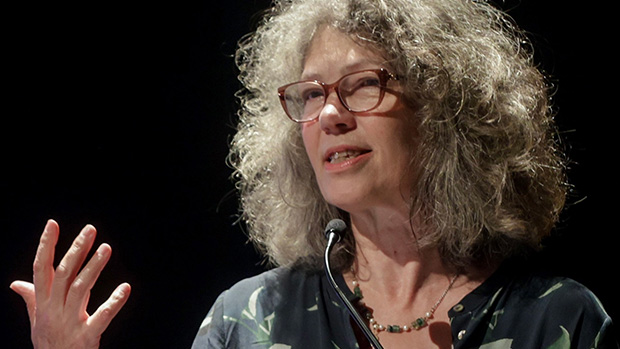
Sonia Livingstone, who spoke at the Children’s Media Summit on Monday
The UK government should not ban social media for under-16s, delegates heard at the Children’s Media Summit on Monday.
The summit, organised by the Children’s Media Foundation, was held to address the crisis in kids’ content, as children defect from public service broadcasting to unregulated platforms like YouTube, and to discuss ways to build a better experience for young viewers.
Among the topics of discussion was whether the UK should follow in the footsteps of Australia by banning social media for under-16s – a move the UK government is currently running a consultation on.
The general consensus among those speaking at the summit was that strict legislation and regulation should be implemented on the platforms to protect children from harmful content, rather than imposing a blanket ban.
“Already it’s clear the ban [in Australia] is not really working. We see children moving from the services that were restricted for under-16s en masse to Roblox, to Discord, to ChatGPT. They’re just all moving,” said Professor Sonia Livingstone, director of Digital Futures for Children, noting that the current UK rules disallowing under-13s from accessing social media also haven’t worked.
Acknowledging that the “risk of harm online is associated with problems offline,” Livingstone pointed out that the practicalities of implementing a social media ban would be problematic.
“I would be much more on the side of banning the business model [of social media platforms looking to capitalise on children] than banning the kids,” she said.
Offering a similar view, Baroness Beeban Kidron, a member of the House of Lords and former film director, proposed banning the social media companies from “accessing” children unless they improve their standards, arguing that “access to childhood should be earned, not assumed.”
“I’ve been working with colleagues in the Lords to make access to children conditional on providing a suitable service. In other words, don’t ban the kids, but ban the companies from accessing them, unless they offer safety by design, high privacy and a duty of care,” she said.
“Companies that expose children to danger or exploit them commercially should not be allowed to have them as customers. And even though that sounds like a ban, it’s not. It’s a condition of entry to a child’s life.”
Jiella Esmat, founder of IP development company 8 Lions, argued that social media platforms should be examined individually, noting that some – like Snapchat and TikTok – are more harmful than the likes of YouTube.
“It’s impossible to call everything social media. I have a very different view, for example, of YouTube, which is moving more and more towards the TV set in the living room, versus a TikTok or a Snapchat,” she said.
“YouTube, in my view, has been a wonderful thing. There are a lot of problems with YouTube because the algorithm is extremely sophisticated, and there is zero transparency on how the algorithm works and functions.
“The positives I see with a platform like YouTube is it has enabled a gateway for young people to express themselves. It has provided a multitude of incredible content that would otherwise not be available to kids and families.
“My 12-year-old spends a lot of time on YouTube watching piano videos, tutorials, STEM-based shows, cookery programmes. There is co-viewing there, there is incredible content. If it wasn’t for YouTube, we wouldn’t have channels like Cosmic Kids Yoga, which is around kids’ wellness, and they’ve since moved off the YouTube platform into the TV environment.”
To get around the issue of the algorithm, Esmat suggests setting up an “FCA-type” organisation that is funded by the platforms “to control and monitor and force transparency of algorithms and back-end information on kids.”
“I definitely do not believe in a ban. I believe in building better. There are ways we can build better and smarter, because banning kids – they’re just going to get around it. Australia has demonstrated this. A blanket ban is just so easy, and it won’t get us very far.”
While against banning YouTube for under 16s, Esmat is not against banning Snapchat and TikTok, where potentially dangerous people could directly communicate with children.
“[We need to] segment platforms into different buckets. People aren’t communicating with one another on YouTube in any real way. They add comments to channels, but there’s not that much internal messaging going on. Whereas within other platforms, that’s prevalent, like Snapchat,” she said.
Also speaking at the summit was Guy Holder, a teacher and co-founder of Set@16. Given the organisation promotes 16 as the minimum age for exposure to smartphones, social media and AI, Holder is in favour of banning social media for under-16s.
Holder called the transition of children from traditional TV to social media a “disaster for childhood” and a public health emergency, but argued that the main way to combat the issue would be to ban children from owning smartphones.
“My message is, we need to get back round the telly and get these devices out of small hands. If we want to get children off social media, we need to tackle the hardware rather than the software,” he said.