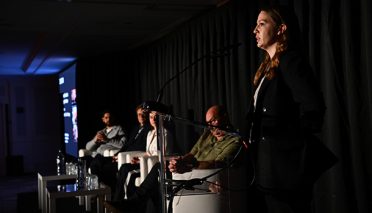

CONTENT EUROPE: Margarida Pereira of Portuguese broadcaster TVI, offers her take on trends in the format industry and the importance of keeping things simple, continuing the C21FORMATS100 strand of executive profiles.
 The global format business is not what it once was. Speaking ahead of her panel session at the Content Europe conference in Lisbon this week, Margarida Pereira, director of acquisitions, sales and international programming at Portuguese commercial broadcaster TVI, offers a no-nonsense diagnosis of the industry.
The market has tightened, the stakes have risen and the appetite for experimentation has narrowed. What has replaced it is a discipline that Pereira, for one, seems to regard as pragmatic. “There is less appetite for risk and more focus on what works,” she says. “Strong, proven IP that can deliver audiences consistently. We are seeing fewer experiments and more strategic choices: formats need to be scalable, efficient and, above all, repeatable.”

Margarida Pereira
The language she uses is revealing: habit, routine, repeatability. These are not the words of an industry chasing the next sensation. “Daily and returnable formats are becoming increasingly valuable because they create habit, which is something the industry is actively trying to rebuild,” she says.
TVI’s own schedule reflects this philosophy directly. The Media Capital-owned broadcaster has built its unscripted entertainment base around long-running franchises, with Big Brother and Secret Story running across the year as structural anchors. “This gives us stability and a very clear understanding of what our audiences want,” Pereira says. New formats are assessed against this existing architecture. What the broadcaster is looking for are shows that can sit alongside its major franchises, building habit without disrupting existing viewing patterns. Among the recent additions to that schedule was Israeli gameshow Intuition from Dori Media at the end of last year and Talpa Studios’ format The Quiz With Balls last fall.
Simplicity, Pereira argues, has become one of the most underrated qualities in format development. “The best-performing formats today are those that are easy to understand, easy to produce and easy to adapt locally.”
It sounds obvious, yet it is a standard that a surprising number of formats fail to meet. In an environment where buyers are more cautious than ever, a format that requires lengthy explanation is a format that is already at a disadvantage. “For us, the first and most important box is simplicity,” she confirms. “A format needs to be easy to understand, easy to explain and easy to produce.” Cost efficiency follows directly from that – the economics have to work within a market that offers little margin for error.

Secret Story runs as a structural anchor for TVI
The arrival of global streaming platforms has reshaped the economics of the format business in ways that are still being fully absorbed. Pereira’s analysis of the streamer-broadcaster divide is nuanced. Streamers, she notes, tend to focus on global, high-impact shows with strong upfront investment, but also with demands for exclusivity and international reach that can make the market more competitive and, in some cases, less accessible for traditional broadcasters. The logic of a streamer and the logic of a broadcaster are, she argues, fundamentally different: “Broadcasters like TVI operate with a different logic. We need formats that work within a daily or weekly flow, build habit and deliver long-term audience loyalty across a full schedule.”
What streamers have done, in her view, is globalise and accelerate the business without rendering the traditional broadcaster model redundant. “Broadcasters remain essential in giving formats longevity, local relevance and real audience connection,” she says. The two models coexist, serving different needs, and Pereira is careful not to overstate the tension between them. “For the time being there is space for everyone,” she adds – a pragmatic conclusion that reflects both confidence in TVI’s own position and a clear-eyed reading of how the market has settled.
The question of consolidation is one that the industry cannot avoid in 2026, given recent announcements from both sides of the pond, and Pereira offers a balanced take. Bigger groups, she acknowledges, bring stronger buying power, larger global slates and more pressure on pricing and exclusivity – conditions that can make it harder for smaller formats and independent producers to break through.
But consolidation is not, in her reading, an unambiguous negative. “It can also create more stability and longer-term partnerships between broadcasters and companies, which is positive if it leads to better development and clearer pipelines for formats,” she argues. The risk lies in what gets squeezed out in the process: the smaller, more speculative ideas that occasionally become the industry’s most significant breakthroughs.

Long-running Big Brother remains popular in Portugal
The broader threat to the format business, as Pereira sees it, is the combination of fragmentation and rising costs without guaranteed returns. There are cheaper formats in the market, she says, but most are designed for niche channels or specific audiences, which limits their scale and impact for mainstream broadcasters. Meanwhile, strong formats are becoming more expensive, increasing the risk for buyers at precisely the moment when their tolerance for risk is diminishing. It is a pincer movement that leaves relatively little room to manoeuvre, and it explains much of the conservatism that now characterises commissioning across the industry.
Against this backdrop, Pereira identifies what she considers the most significant opportunity available to format creators and distributors: the development of ideas that create habit and bring audiences back every day. “In a fragmented market, anything that is simple, addictive and easy to follow has a real advantage,” she says. She also points to a clear opportunity in refreshing familiar genres, particularly gameshows and entertainment formats, by adding a new twist that makes them feel contemporary.
This is consistent with one of the dominant creative trends she observes across the current market: a return to the past, with successful formats being revived and updated for modern audiences. “Overall, the trend is less about new ideas and innovation, and more about revisiting what already worked and refreshing it for today’s audience,” she says. “Honestly, we are not seeing many truly new ideas at the moment – at least not yet at a scale that really breaks through internationally.”
Alongside the revival of proven concepts, Pereira detects a strong move towards big, spectacular entertainment – formats with scale, large set-ups and high production values that feel event-driven and visually impactful – as well as the return of solid, structured formats with strong mechanics and clear rules. The common thread running through all of these trends is familiarity. Audiences, it seems, want to feel orientated, and format creators are responding accordingly.
The geography of format innovation has also shifted, though perhaps less dramatically than some would suggest. For Pereira, the UK, the US and the Netherlands continue to lead in exporting and developing strong, scalable intellectual property, sustained by well-established relationships between producers and broadcasters and deep accumulated experience in format creation.
Israel, she notes, was once among the most innovative territories in the world, but its output has naturally slowed in recent years given its ongoing conflicts. South Korea and Japan continue to stand out for originality and strong visual ideas, though she observes that their formats often require significant adaptation to travel successfully.

Talpa Studios’ format The Quiz with Balls
On AI, Pereira says TVI is already using AI tools in its development process, but within clearly defined limits. Data analysis – understanding audience behaviour, identifying trends, supporting decision-making – is where the technology is currently deployed. The creative process itself, she is emphatic, remains entirely human-led.
“The editorial judgement, idea generation and development continue to rely on experience, intuition and creativity. For us, AI is a support tool on the analytical side, not part of the creative construction.” Her assessment of the technology’s broader potential and limitations is put with characteristic precision: “Formats are not just about data – they are about emotion, intuition and cultural understanding. And that is where the machine still cannot compete. It can process information, but it cannot ‘feel’ what will connect with an audience. So I would say AI is a very smart assistant, but it is not yet a storyteller. And in our business, storytelling is still everything.”
When it comes to looking further ahead, Pereira is candid about the limits of prediction in a market that is moving too quickly for confident forecasting. Audiences are becoming more fragmented, discovery is increasingly driven by algorithms, and content is being consumed in shorter clips and across a greater variety of platforms. These trends are likely to continue, she says, but they could also shift quickly if technology or platform dynamics change in ways that are currently impossible to anticipate. “Instead of a fixed forecast,” she suggests, “it’s more useful to think in terms of current trends and accept that they may speed up, slow down, or change unexpectedly.”
What does seem clear, across all of Pereira’s analysis, is that the format business is entering a period in which the fundamentals matter more than they have in years. Cost efficiency, emotional connection, simplicity of execution, audience habit: none of these are new ideas, but all of them have acquired renewed urgency. For broadcasters like TVI, operating in a competitive market with a loyal but demanding audience, the strategic challenge is not to chase every new wave but to understand which ones are worth catching.
The C21FORMATS100 is an editorial initiative to profile 100 key players defining the future of the formats business, publishing on C21Media.net across the year and culminating in the publication of the C21FORMATS100 ALMANAC at Content Europe 2027. This initiate is designed to provide a roadmap for the evolution of the formats genre and get inside the minds of some of the most creative players in the sector.