The Vaughan identity
 21ON21 YEARS: Lookout Point founder Simon Vaughan started out as a child actor and has become one of the most successful drama executives in the business, most recently selling his company Lookout Point to BBC Studios. He tells David Jenkinson about the journey and what lessons he learned on the way.
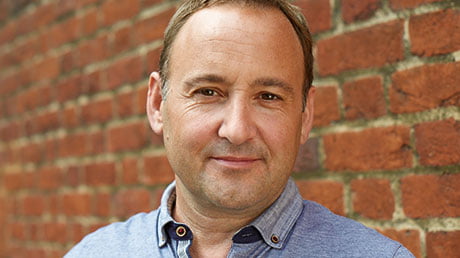
Simon Vaughan: “I wasn’t a very good actor. I would have producer thoughts, even about the casting process.”
Let’s be clear from the start, Simon Vaughan is a friend of mine. For more than 21 years, as C21 charted the highs and lows of his career, I have come to know him well. Because of that, you may think it would have been better someone else wrote this story. But I’d say not. See what you think.
Vaughan was a child actor and had his first brush with the camera as a young Sid Snot in The Kenny Everett Video Show in 1985. The experience introduced him to the BBC and BBC Television Centre – the iconic building in West London that played a significant role throughout his career.
A few years after his debut aged 12 he got a part in iconic kids’ drama Grange Hill. Even though the series was filmed at Elstree Studios, Television Centre was again where the special stuff happened: charity football matches, manning the phones for telethons or very important meetings. This was a special place for Vaughan, who still gets a thrill walking through the gates today.
So he was no doubt buzzing when he went back in September for a 40-year Grange Hill anniversary dinner, not as the once famous but now tragically ageing Freddie Mainwaring, but as one of the world’s most successful drama producers, having just sold his company, Lookout Point, to BBC Studios in a significant multi-million-pound deal.
In Grange Hill speak, that would earn a “Flipping heck Tucker!”
He reflects on those early visits: “It was always a pretty extraordinary experience going to Television Centre, because it really was the home of television in the UK. And today the BBC has a role to play that is more important than ever.” But more of that later.
Grange Hill was huge. These were the days when there were only a handful of magazines on the shelves, no internet, no email, no social media and no magazine programmes, except Saturday Superstore. “It makes you feel 300 years old,” says Vaughan. “But things were so different back then. What I didn’t realise until I was on the show was that 10 million people watched it. You’d walk out on the street and everybody who was aged between five and 20 knew you. It wasn’t pockets of people, it was everybody. So you did become very famous very quickly.
Things certainly were different – particularly in how child actors were treated. “Kids weren’t really looked after in the business before Harry Potter,” says Vaughan. “A coach would pick you up from Angel Islington Underground station at 6.30am. It would be dark. You would have somehow got yourself to the station in the early hours. The bus would take you to Grange Hill and then it would drop you back at 7.30pm. And you’d have to get home.”
As one of the most famous kids in the country he would then have to make his way through the mean streets of the Caledonian Road, hoping not to get beaten up, “or if you were, hoping they’d be able to cover it up with make-up.”
“There was a danger it could screw with the rest of your life if you were unlucky,” he adds. “I remember doing my 0 Level exams with a taxi waiting outside and somebody saying to me, ‘I know it’s important but is there any chance you could finish a bit early and get the taxi?’”
This was one of the reasons, Vaughan contends, that he left school with no qualifications.
But his time on set had lit a fire that would be stoked throughout his career. “I wasn’t a very good actor and I didn’t like the feeling of not being in control,” he says. “Whenever I got something I’d think, ‘Oh, I wouldn’t have cast me, I’d have cast…’ Normally I thought of Lee Ross, who was the better actor. And so I would have producer thoughts even about the casting process and I’d find I would talk to people about that sort of thing on set.”
Vaughan quit acting and started his first company, Wishful Thinking, when he was 17, making fitness videos. “Largely speaking, I do the same thing now,” he says. “Find rights, then find a way to finance and distribute them. It’s pretty much unchanged for 30 years.”
Working in the video sell-through business he was offered a job by one of his clients, Pickwick (part of Carlton Television) and then headhunted by BMG.

Ripper Street was cancelled after S2 on the BBC but was picked up by Amazon
As head of acquisitions at BMG he was in charge of a £10m (US$13m) budget, but soon realised there was nothing to buy worth having. “As the Netflix’s and Amazons of the world know today, anything that is left to acquire at the end isn’t really worth acquiring. Everything is ‘gone’ that’s any good,” he says.
“So what we had to do was commission and make shows ourselves. Great projects didn’t grow on trees, and if we wanted to have global rights to content we had to pay for it to be produced.”
Vaughan commissioned a number of shows: Wind In The Willows for Disney and Peter & The Wolf starring Kirsty Alley and Lloyd Bridges, which won an Emmy for Best Children’s Programme. “Exactly the same thing, I imagine, that has driven Amazon and Netflix to want to produce their own content,” he says.
After five or six years, having moved to the US to continue the job, he stumbled across the rights to Richard Adams’ book Watership Down, which had been a “heartland fabric-of-life piece. I tried to sell it to the company but nobody was interested,” he adds.
That was in 1997 – conveniently, 21 years ago – and provided the opportunity for Vaughan to wrap up what he had learned to date and take his first steps into the world of independent creativity.
“I remember having to go to Martin Rosen, who had written and directed the first Watership Down movie, and say, ‘Look, BMG don’t really want this but I do, and if you are prepared to give me a break, I’ll form a company around this project and get it off the ground.’ Which I did.”
Vaughan launched Alltime Entertainment on the back of the Watership Down rights and set about building a business. “I was very inspired by Hit Entertainment, which seemed to do a few things really well and super-serve the creative. So I thought that’s what I’d do too.”
Alltime made 39 hours for ITV, Disney Channel and ProSieben, with some Canadian coproduction and Korean animation thrown in for good measure. “And along the way I learned the coproduction business,” says Vaughan.
But coproduction is a tricky beast. And these were the days when it was seen as the grubbier end of the market.
“People would cross the street to avoid you at Mip,” he says. “‘He’s the bloke who does those stinky old coproductions.’ They were good shows, things like Ben Hur and Coco Chanel and The Company with Ridley Scott, but people thought that because they weren’t fully paid for there was some sort of deficit. They were mainly miniseries constructed with global partners. They were not the shows being made directly for a US or UK network.
“The rules of coproduction are that you just make the thing you want to make and you don’t let the financial structure inform the creative process. It’s taken me and the industry years to learn that, with coproduction, you just can’t follow the financing, you have to follow the creative impulse. But in the early days, coproduction had a pretty bad name.
There were still big DVD advances back then, dwindling seven-figure sums that could be bolted on to financial plans. The industry had been relying on 10-15% of a US$10m budget coming from DVD.
“When SVoD came along, many in the business thought one day, just maybe, SVoD rights might replace DVD revenue,” says Vaughan. “What you didn’t realise was that not only one day would it replace what DVD had done, but it could pay for the whole thing. That would have been unthinkable when you had these diminishing DVD numbers that you were plugging into your plans, knowing that business was fading.”

Titanic was developed with Downton Abbey scribe Julian Fellowes
With the content business in such a state of flux, with the FAANG players (Facebook, Apple, Amazon, Netflix and Google) reshaping the creating and commercial landscape, what does Vaughan think of the future of coproduction, it having been such an important part of the past?
“Coproduction is interesting. I’ve seen it come and go and come and go and come and go again,” says Vaughan.
“Right now it’s more about production that coproduction. But I think it will change. All the platforms that aren’t one of those global goliaths are going to have to coproduce and co-finance a lot more if they are going to remain in the business. So we’ll see a new boom in coproduction for the public service and local broadcasters and that will forge a new, buoyant era of coproduction in order to create global shows that can compete with the SVoD players. Coproduction isn’t going away.”
Alltime grew but over-extended itself along the way, launching Kidstime.com as a preschool content and retail portal towards the tail end of the first internet boom with the backing of Flextech/Telewest. The market wasn’t ready and it led to a destabilisation of the company and Vaughan needed a way out.
He joined Power Television and created a drama division run by Justin Bodle. “I learned a lot from Justin Bodle and my days at Power TV,” says Vaughan. “The most important thing I learned was that it’s important to have balance in partnerships, and for all parties to feel fairly treated and to benefit from success. Appropriate credit where it’s due and fairness and generosity are fundamental to being able to work with people on a long-term basis. In success there is plenty to go around and it’s more fun to share.”
During that time he got 10 to 12 big British projects away, with Power’s role being to arrange the global financing. It was always a rocky relationship and finally, in 2005, Vaughan fell out with Bodle and left to launch his own company, Alchemy, with Nick Witowski, who he had worked alongside at Power.
But how was that going to be different? “What we tried to do was to leave a little bit more meat on the bone for everyone. What we had been doing at Power was snaffling the rights – ‘We’ll give you the money you need but we’ll take absolutely everything forever.’
“That becomes really unenjoyable when you’ve got friendships with producers who are coming to you because there is no other way of getting their shows funded and you’re running off with everything.
“We felt we had to do something where we could help people finance their projects but with a little bit more restraint and fair mindedness.
“I’m known for being quite aggressive in business but what I’ve learned over the years is it has to be good for both sides. Nearly every relationship we have now is a repeat relationship, and if they are not that’s real failure. While you go through your ups and downs and every one of them is a minor or major miracle, the measure of success for me is that you get to work with the same people again. Mostly we do that by being just that little bit more reasonable, strong-minded creatively but fair-minded commercially. And trying to balance that equation so everyone does well in success and nobody is left hurting.”
In the early days, Alchemy fully funded its shows up front. It would cobble together a pre-sale in Spain or Italy, a commission out of the UK, maybe a copro deal in Canada. When it had the contracts in place it would go to the bank, which would lend the company the money to produce. But gradually the debt markets opened up and lenders were prepared to underwrite production.
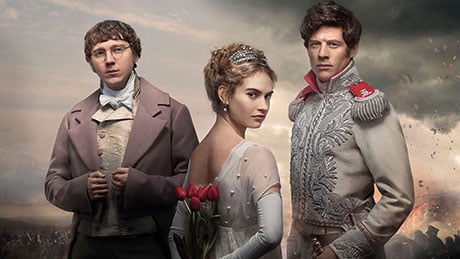
Lookout’s remit with War & Peace was to “fund an impossible production”
“Debt was cheap and fashionable,” says Vaughan. “If you didn’t have a decent line of credit you weren’t worth your salt. People would swagger down the Croisette measuring their success on the amount of credit-worthiness they had. Even at Alchemy, we had US$70-80m of credit facilities at a time when there were specialist media banks lending. What we were doing was building greater and greater deficits built on debt.”
Then there was a slowdown in the market, stock market crashes, resetting and retrenchment in the money markets.
“The bank wanted their money back. If we controlled the overhead, which basically meant sent everybody home, and went into a collection mode on projects like Flashpoint which were generating cash, the bank would get its money back and I really had no choice but to agree with them and to let that happen.
“It was very disappointing, but there had been a lot of great shows made during that time and I was not going to be defeated.”
He picked himself up, brushed himself down and launched Lookout Point with his wife, Justine. “Lookout Point was the name of the treehouse in our garden when our children were growing up. It was never a company name but was also a folder on my computer where I kept my fun stuff, my creative ideas, named after my children’s treehouse. But it turns out to be quite a good name.
“I got three credit cards, borrowed 15 grand on each and used that as working capital. I managed to buy some assets from the bank, who were happy to sell me my development – Ripper Street was one of those shows (I’d thought it up when I was at Alchemy), Titanic with Julian Fellows and Goodbye Christopher Robin, which was a movie we launched last year.”
The business was once again focused on two or three projects, harking back to Vaughan’s respect for Hit Entertainment and doing just a few things very well. “We developed Titanic with Julian Fellowes and Ripper Street with the BBC and just tried very hard to get them made.”
But, he says, he wouldn’t have been able to do it if Helen Jackson at the BBC had not backed the business.
“Very early on she recognised that there was something about my global experience and catalogue. When Alchemy ceased to be viable, Helen asked me what I needed, and I had very modest needs at the time. She and Wayne Garvie supported the new business. We did a first-look deal that absolutely saved our bacon. Nine years ago this September we incorporated the company and Lookout Point was built on those foundations, based on Helen’s belief and investment.”
Drama is a slow business, but because Ripper Street had been in development for a couple of years it got picked up within a year or so of the company launching. “We were off and running fairly quickly. And then Titanic got picked up as well,” says Vaughan. “And I then began getting approached to be involved in other people’s projects.”
Lookout Point was coming of age in many ways for Vaughan and his experience in other areas of the business fed into the company. Things had changed a lot by then and, if anything, the independent spirit of hard-won success was finding new opportunity beyond the traditional business.
Most notable was Vaughan’s refusal to see Ripper Street die when it was cancelled after season two, and he fought to get it recommissioned by Amazon. The streamer provided a new finance model and went on to underwrite three more seasons, with the BBC buying in as a partner. This was a whole new ballgame and defined creative deal-making.

Vaughan launched Alltime on the back of the Watership Down rights
“Having a returning series is the lifeblood of any company, and I wasn’t about to see Ripper Street die after two seasons,” says Vaughan. “Chris Bird at Amazon became interested in what people called for a little while the ‘Ripper Street Model,’ which was picking up a series that had been cancelled and keeping it going.
“It was really valuable for the business, and also reputationally, because it displayed an entrepreneurialism that was true and at the heart of Lookout Point. The secret of our success was that we always tried hard.”
Another landmark show during this period was War & Peace with Faith Penhale at the BBC, who ended up joining Lookout Point as CEO following production. The show was developed by Penhale and Andrew Davies, Lookout’s remit being to “fund an impossible production.”
Harvey Weinstein heard about the project and wanted the US rights, which, in the end, he got. It was not a pleasant experience for Vaughan.
“We needed an American partner and Harvey stared ringing. Harvey was a great trophy hunter and he would look for these big important properties. War & Peace epitomised the sort of project he was interested in,” says Vaughan. “What started as a very positive approach turned into mission creep that would go from being a passive licensee to wanting input, opinions and absolutely everything. In the end we got through it and out the other side, but it was certainly the hardest business relationship I have been in by miles.”
The relationship with BBC Worldwide (now BBC Studios) had been getting closer during this time. Initially it bought 25% of Lookout Point in 2010 and owned 49% by 2016. Finally, it acquired the remaining 51% this July.
“What we are offered as part of the BBC group is the most stable platform there is to build a global studio of our own,” says Vaughan. “The British model and the Lookout Point model is to create an environment where people feel safe to do their best work, be protected and nurtured and their assets carefully managed. Which is why it is possible for companies to survive in the digital age.
“The BBC is our biggest customer and it will always be. But the BBC is a very far-sighted organisation and wants us to pivot towards a global marketplace. The BBC, and Lookout Point within it as a drama hub, is uniquely focused to be the last independent.”
Vaughan cites the mega-merger environment in which the company operates as an opportunity for growth. “There are two trillion-dollar companies out there right now (Apple and Amazon), but there are going to be several more,” he says. “Right at the heart of those companies is the need for content that keeps people on their platforms. So content is a huge part of the essential firepower of the richest companies that have ever existed on the planet.
“Let’s say there are eight to 10 trillion-dollar companies over the next couple of years. But the BBC can’t be sold, it can’t be merged, it can’t be stock market-listed, it is not subject to advertising. It has this unique, almost United Nations mandate where the best version of it should be the most important supplier to all the platforms.
“So why I wanted Lookout Point to be part of that group, over and above my nostalgia, is that it is positioned to be the most important independent company. The BBC is, by nature, independent due to its royal charter and it has the trust and behavioral restraint to be able to create fair-minded deals with each of the platforms. But it can’t be dominated by any of them.”
There is also another reason Vaughan champions the BBC as the place to be: “It’s about quality, not money, which is a value system that fits well with artistry,” he says. “We all know hits come in surprising forms. Happy Valley is an example of that. It’s not a show that plays to the crowd, but it is a hit. Breaking Bad is another example. It’s about niche brilliance that travels into a mass market. And that is not an algorithm business.”
Looking back over the 21 years since he took that step to become an entrepreneurial producer, what does Vaughan think have been the biggest changes?
“Clearly the internet and what that has provided SVoD,” he says. “The big gain is more content, but loads of time has also been eaten up. And behaviour has changed. It’s all a little less showbiz and that makes it more difficult for people like me, who hustled their way through back in the day. It’s now about very stable companies buying from very stable companies their best work. It’s an overall gain but it is harder to be a character in the business.”
Vaughan believes that the maverick spirit now comes from writers rather than executives. “Our job is to create insulated and comfortable environments for those mavericks,” he says. “The growing value of authorship has been gained and true respect for the power of the pen. In future, those people may simply publish what they want, when they want to and there will be platforms to allow them to do that.
“What has been lost is time. We are processing so much information. The people I admire most are the people who seem to have time to focus on you in the meeting and on the material. And that’s something I strive for – to make time for the important things and make them count more.”