Mipcom 2026 – all windows, no fresh air
By Siobhan Crawford
15-10-2026
C21’s resident formats expert delivers her key takeaways from this week’s Mipcom and the questions she’s leaving Cannes with.
Mipcom 2026 – it physically pains me to say – is over. This is the pinnacle of our work year and in the blink of an exhausted eye it has gone. Roll on 2027, but first let’s dissect this (long) one.
The topline
This year’s Mipcom was curated to bring new media into the old media world, with the Brandworks crossover and the prominence of YouTube – the thing we are all told is essential for survival. The concern I have is are people changing how they ‘Mip’ in reaction to changing times? I think not.
Almost 9,000 people plus the extras came to Cannes. We sat in the sessions teased with the word ‘new’ in the title but continued to repeat our patterns of years past. It was a Mipcom where line-ups were aggressively communicated pre-Cannes. The town was not full and the tone was ‘head down and work’ – it was not as festive and even Brown Sugar felt different from normal. For many, there is talk of a plan B. This may be a Mip you missed or it may be your last because of circumstances. You may be thinking the big thoughts like me. But what were you expecting? What did Mip need or want to be for you this year?
The takeaways
• The data – God, I love it. I don’t love the ‘Great Depression’ title research company The Wit gave it, but here are the headlines: a 62% reduction in new formats compared with 10 years ago, with 2013/14 considered the peak of our industry. The UK is hardest hit, with 63% fewer format exports (ouch), and there have been no format exports from Israel since 2018, though there are hopes this will change with the new Keshet offering. The positive is that formats are taking less time between country adaptations – one year. The bad news: Banijay now accounts for at least a quarter of all format deals, and Spain has a 4:1 ratio of foreign to original formats on air. Crazy, but thankfully Catalan pubcaster 3Cat plans to right this!
• Words of the week: ‘fandom’ and ‘windows.’ Yep, YouTube is apparently responsible for opening up and providing access to fandoms, upon which every success is built. And to reach them we have to maximise and multiply our licensing/exhibition windows: first YouTube, then linear, then streamers, plus social activity around each. No cannibals here – we are a happy herd.
• “More is more,” said Deborah Bradley, executive VP of global content sales at A+E Networks, during the Unlocking Hidden Audiences and Revenue on YouTube session. She was clear that while we are all nervous about diluting control of strong IP, the new normal looks like we have to place content in many places for relevance, to attract a new generation of viewers and maximise value. That means we should see a rise in licensing.
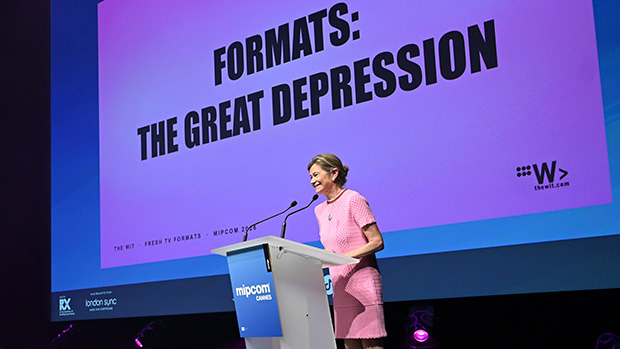
The Fresh TV Formats presentation with Virginia Mouseler
• The Fresh TV Formats session. I praise The Wit founder Virginia Mouseler for putting on this spectacle because the place was packed. The trends: apparently digital-first formats do not have structures but they do have talent and older people are popular again, with their unpredictable voices, as shown in Facing the Nursing Home and Granfluencer. I cannot help feeling we are chasing a successor to The A Talks, but I do like Keshet’s Who Wants to Start? as it takes the idea further. The Bluff and The Imposter both show a trend for taking dark, strategic gameplay into the studio. Denmark and Belgium are on the rise as format creators and are in the spotlight.
• KOCCA (Korea Creative Content Agency). I love that both South Korea and Japan put on showcases, as we know there is an appetite for their fresh content – and perhaps one day they will bring actor Byeon Woo-seok. So they have my continued full support. But from a Western viewpoint, this presentation style is not the most productive way to run a showcase we genuinely need. Each leading prodco pitched one show (Throw 4 It, Synchro Game, The Logic, TXT Parenting Diary etc) in a detailed but confusing way. Apparently physical coins, big contestant groups and rival groups are popular in Korea now, but the formats need a new way of being presented.
• Top trending formats. As always, the Euro pitch rankings were discussed – the top five included Ex-scape Island from Satisfaction/Banijay and, from BBC Studios, The Yacht, Silent Attraction and Big Date. We also know War Games from NBCUniversal has generated some curiosity as a spectacle, but I think we heard more people ask about Dutch format house Talpa’s Sing With Me, which is rumoured to have landed an ITV commission. The Big Date and The Yacht I get – they feel fresh, almost the social experiment we have all craved – but that’s all I get.
• Cable channels are a dead or dying beast. OK, well, bold.
• We are in an attention economy. We know this but maybe we are also in a Mad Men marketing world, where you place content on YouTube as a tool to draw people (Gen Z) to your SVoD platform and your linear broadcast is just an advert for the digital catch-up. Advertiser-funded programming and marketing campaigns are not the same thing: one is funding with a touch of established fanbase, the other is purely about bringing in the eyeballs. Is free broadcast media now the marketing campaign/tool for digital?
• The introduction of brand-funded content into mainstream media has distorted how creators think – there is a belief that brands will fund entire series while adhering to creator caveats. Let’s manage those expectations: brand funding is one part of the puzzle, alongside self-funding, presales and windowing.
• The reaction of the indies. The Banijay merger has upset many. The withdrawal of All3Media titles from the indies is forcing them to question their survival, and part of the response seems to be unofficial networks popping up for co-operation and acquisitions between unaffiliated prodcos. This is a different approach for paper formats too, in a world that is not friendly to paper right now.
• The very delightful Canadians have money. I have been allowed to report that they may be very selective and may schedule for 2028/29 (facepalm), but go and see the power ladies we all know. (You’re welcome, J!)
• Literacy rates. This is fascinating: in the Netherlands and Denmark, studies and news reports have pointed to declining literacy rates, linked directly to screen use by younger generations. So now an action plan is needed to counter this. Meanwhile, there has been a notable increase in spoken English (with an American twang) and a reduction in native language use.
My take
I have never Mip-ed the way I Mip-ed this year. I went to five or six sessions (and I wish I had had time for more). I had a slow Sunday morning. I met only a select number of people. I had interesting philosophical talks in auditorium queues and I generally had the capacity to think about this beautiful industry.
After 35 Mips, I felt that if anything was going to change, I needed to change, so I met different people. I asked the question, “What do you need?” and really listened to the answers. I walked the bunker taking notes and really looking at content, and I talked to friends about how they are upskilling themselves proactively to better navigate their future. I asked myself what I needed to fit into this new world and how I could do this while making money, where it feels like connections at the right time are more important than being a good salesperson. ‘Distributor’ is not the right word now – you need to be a ‘connector.’ FOMO won’t get the show commissioned, but strategic thinking will, and honestly, that is the best/longest reward for hard-working people.
In my head, these are the questions I asked;:
• Is it more financially rewarding to have YouTube or FAST deals?
• What does a YouTube deal actually mean in real numbers, because ‘keeping over 50%’ is not really a business model?
• Why do content creators want to move to old media? Is it because that is where the big money and the eyeballs they aspire to are – beyond the gaze of Gen Z alone – to legitimise them (think Dancing with the Stars appearances), when they keep saying they want control?
• When have we paid enough for content? I have five-plus streamer subscriptions and I do not pay to go ad-free. Now apps are being created to curate content creators’ material on one paid-for site, away from YouTube. It is like Substack, but who will pay more?
• Are viewing numbers/engagement more important than revenue now? Are we creating fandoms at whatever cost to create IP with longevity across the generations?
• In a world of reboots, why do we continue to innovate? It feels like all the ideas have been seen before, but we never go back toredevelop those. So is innovation second to ownership?
And to balance out all that thinking, Mip is also a place of gossip and speculation, so there was plenty of joy too, just not a lot of sleep! Rest up well, dearest.