How to de-risk new format launches
By Siobhan Crawford
21-07-2026
C21’s resident formats expert examines how format broadcasters and creators can de-risk their new launches, citing examples including The Traitors and Most Wanted.
In 2026, ‘risk’ prevents many new formats from launching and the ones that do launch are prized possessions that should be treated as learnings for the rest of the industry.
But Lord knows, the risk is not in the idea – it’s in the reception.
Innately, an untested idea is a wild thing. We have no production learnings but we also have no analysis of the demographics to compare to our own markets. So in a world where The Wit has told us there has been an eight-fold reduction in new formats launching and travelling in the past years, just how can you reduce risk? Are there any elements we can control better or foresee and manage? How can we show a commissioner we have thought beyond the concept and into the nitty gritty? Do marketing budgets (at a time of no ad-spend) make the difference between success and failure?
I am going to use examples to ask if there are things we can do to make risk less risky, and less of an excuse for not trying new formats.
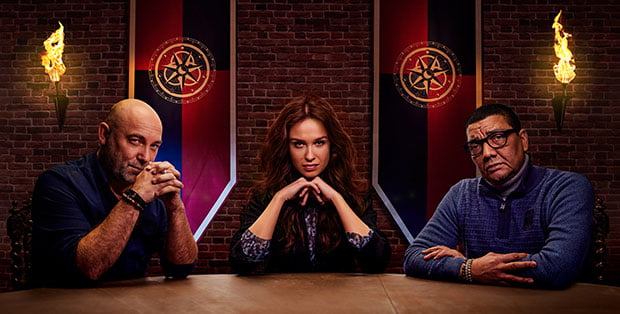
The original version of The Traitors debuted on RTL4 in the Netherlands
Example 1: The Traitors
The biggest format of the past five years, which ‘originated’ from a 16th century story of sailor mutiny in a book Marc Pos read many moons ago. OK, well… next. It launched in 2021 in the Netherlands on RTL4 after about eight years in development. It has now travelled to more than 30 countries with mostly successful launches. How did All3Media, IDTV and RTL reduce the risk on this format?
It was 2021 and the most famous format in the Netherlands for the past 20-plus years had been The Mole, locally titled Wie is de Mol?, created in Belgium in 1998 and on air in the Netherlands ever since. Traditionally, each season launched on the first Saturday of the new year, running till March, like clockwork. It easily achieved more than two million stable and reliable live views per episode with potential to double this number in consolidated viewing. Now WIDM (the Dutch acronym for the series), in the many, many years it has been beloved, was licensed and produced by production company IDTV (All3Media), the co-creator of The Traitors.
In 2021, was WIDM broadcast as normal on NPO1 from Saturday January 2 to Saturday March 6. The Traitors (De Verraders) launched on RTL4 on Saturday March 13, 2021 – the first Saturday after WIDM finished – when a vacuum existed for the two million-plus Mole fans.
Coincidence? I think not – especially when you consider the press from the first announcement in January. Verraders was announced and discussed as a ‘successor to WIDM,’ ‘from the makers of WIDM’ or even ‘WIDM 2.0.’ RTL often emphasised this format was from the same producers as the successful WIDM. Social media was abuzz with the ‘Mol 2.0’ phrase. The press campaign to the Dutch audiences was exhausting and thorough: in every breath when they said ‘Verraders’ they said ‘WIDM’ too. It was RTL’s best tool to ensure an audience.
The press at the time also compared it to another format other than The Mole, namely Verraders: The Werewolves of Wakkerdam. This was a card game created in 2001 that is beloved around the world, meaning it was already in the zeitgeist and familiar.

Most Wanted began life on YouTube in the Netherlands
Example 2: Most Wanted
No one can talk about de-risking new launches without mentioning Signal Stream – it is the OG in this field. So we are going to keep Dutch.
The trendy way to de-risk a format today is to go digital-first. But there is an art to it. With a fraction of the budget, you can create a proof of concept and some statistics before moving to linear distribution (which is everyone’s goal). This is the business model for Signal Stream that started with the biggest YouTube channel in Netherlands, Stuktv.
From here, it launched Hunting Season/Most Wanted, or Het Jachtseizeon, the original celebrity chase format that launched on YouTube in 2016 as a series of special episodes featuring influencer-style celebrities. The series was compatible with sponsorship by brands plus partnerships for second windows with local-language SVoD streamers. An app was created but the key feature was the compelling need to use social media to interact with this format.
From 2016 to 2024, one season was released throughout the year on the YouTube channel, increasing in popularity as social media users wanted to be part of the hunt. Then, in 2021, in addition to the YouTube series, came the 2021 ‘television’ version created for SBS6, in partnership with Amazon Netherlands. To be clear, the YouTube series continued separately, with one younger influencer-style talent per episode, while on the linear series a pair of slightly older celebs was cast. This model continued until 2024 when the format launched to the international community and moved to a pure commission by RTL’s Videoland, where it continues today.
So you had a YouTube series with a shorter form (about 25 minutes) that compelled you to play along with social media (also by the nature of the hunting game), then curiosity encouraged people to also watch the 40-minute older demo linear series, plus SVoD catch-up and physical marketing in towns. Plus the biggest draw: “Chase live across TikTok, Instagram, YouTube, radio and TV. Activating fans 24/7… launched with live TV integration.” The reason – because the hunt was almost in real-time, produced only a few days before broadcast, and everyone wanted to join in.
Market penetration was achieved by tailoring one concept to two demographics in a cost-efficient way, where social media was the marketing campaign but the series continued to get bigger and bigger because the coverage did, until the RTL Videoland commission saw all versions rolled into one supersized, epic format – only on their streamer.
This was a different way to launch than just digital-first. This maintained two streams of content, two sources of income, two audiences and grew a brand across multiple platforms. In 2024, it started to roll out globally, in the old-fashioned linear way.
De-risk/analyse/manage
What these examples are telling us:
• Origination does not spring from nothing – you need something to launch from, build upon, whether it is an existing audience, product or genre popularity.
• We talk about timing: zeitgeist, watercooler, ‘relevance.’ But never has this been truer. Precision campaigns hit a specific audience.
• How you bring the format into the spotlight is vital. This does not have to be through celebrity casting alone as we have been led to believe, it can be what is familiar or it can be saturating socials.
• Genre saturation is bullshit. You can lean into a trend. Co-existence is entirely possible but also a genre has to exist for its successors to follow.
• De-risking requires a quick international pick-up – think how The House of Hide & Seek was sold into Spain before it even launched in the Netherlands.
• Clear branding and visual identities across platforms, press coverage, anywhere. Orange jumpsuits, a dark hooded cape. It is market penetration that creates audience curiosity.
• We do not have to talk about one way of doing things. Things can be in parallel and sometimes things grow over time if we manage expectations.
The crux
Let’s keep in the front of our minds that if you want to de-risk how a format starts its life then strategy is essential. Never just launch your baby and pray. This is methodical. You need to keep your audiences entertained, active, curious and familiar all at once if you are to de-risk.
Put your analyst’s hat on. The TV of today is your university – study it.