MIA puts finance centre stage in radical revamp
By Louise Bateman 06/10/2026
Rome’s international audiovisual market MIA is spreading across seven venues for its 12th edition, adding a European Investment Hub and a gap-financing market for broadcaster-backed animated series.
Financing and investment for the European content industry, including gap financing for the embattled animation sector, will form a key focus of the 12th edition of MIA, the international audiovisual market held annually in Rome.
This year’s event, which runs from October 19 to 23, will have a much-enlarged footprint across the Italian capital and present its biggest programme yet, in what organisers describe as a fundamental reinvention of the market.
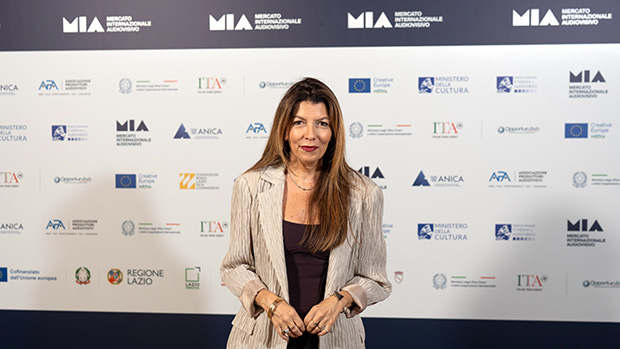
“What I’m describing this year is a Copernican revolution for us,” MIA director Gaia Tridente told journalists at a briefing ahead of the event. “We’ve shifted from one single event organised in one conference venue to a new dynamic and a new market experience.”
A centrepiece of this year’s event is the European Investment Hub, which Tridente described as one of the most structurally significant new initiatives.
The hub runs during the first two days of MIA. Day one focuses on European public funding, with representatives from the European Commission, the European Investment Fund, CineRegio, Eurimages and the Italian Ministry of Culture.
Day two is dedicated to private capital, with a programme covering gap and bridge financing, global finance, equity, growth capital and private credit, according to Tridente. It will look at how companies can attract investment not only for individual films or series but also for slates, IP portfolios and long-term company growth.
Private investors and finance specialists confirmed for day two include Christopher Woodrow, founder and chairman of Media Capital Technologies, and its CEO Raj Singh; Celine Dornier, content executive at IPR.VC; and Roeg Sutherland, co-head of CAA’s Media Finance department. Further names will be announced.
The hub will also look at emerging sources of capital such as brand partnerships. “We will explore brands as new potential partners,” Tridente said, noting that companies such as Dentsu Entertainment and Jaguar Land Rover will be present. She added that the hub will also examine how film and audiovisual IP can generate value beyond its original medium, including through video games.
New this year is the Animation Series Gap Financing Market, a programme dedicated exclusively to animated series that are already backed by broadcasters and largely financed but are still seeking coproducers, co-commissioners and international distributors. Producers will present their projects to a panel of decision makers in a bid to complete their financing.
Those confirmed include Cecilia Persson, MD of kids and family at BBC Studios; Arne Lohmann, VP Junior at ZDF Studios; Pierre Siracusa, director of young audiences, education and animation at France Télévisions; Coralie Boitrelle-Laigle, youth programming director at French broadcaster Gulli/M6; Izabela Rieben, commissioning editor for drama and animation at Swiss pubcaster RTS; and Julie Lind-Holm Hansen, commissioning editor of animation at Danish pubcaster DR.
They are joined by Marc Janssen, head of fiction, and Tristan Moreau, editorial and content advisor, both at Belgian pubcaster RTBF; Cecilia Padula, VP and brand head of kids and family for South EMEA at Paramount; Roberto Genovesi, director of kids at Italian pubcaster Rai; Vicky Schroderus, senior executive in charge of international coproductions and acquisitions at Finnish pubcaster Yle; Chapman Maddox, development executive at BBC Studios; Nicola Andrews, VP of sales and acquisitions for kids, family and young adult at Blue Ant Media; Diego Ibáñez Belaustegui, chief brand officer at DeAPlaneta; and Monica Levy, co-chief of distribution at Federation Studios.
The editorial programme has expanded to more than 40 sessions, including industry conversations, fireside chats and panels, with more than 85 international speakers. Speakers include Marco Bassetti, CEO of Banijay Entertainment; Jane Tranter, founder of UK indie Bad Wolf; Anna Marsh, CEO of StudioCanal; director and screenwriter Edward Berger; Maria Pia Ammirati, director of Rai Fiction; Eleonora Andreatta, VP of Italian content at Netflix; Giampaolo Letta, VP and CEO of Medusa Film; Emanuele Marchesi, executive VP of Sky Studios Italy; Nicole Morganti, head of local originals for Southern Europe at Amazon Studios; and Laura Carafoli, senior VP and head of content for Southern Europe at Warner Bros Discovery.
Among the highlights will be the eighth report on the state of Italy’s audiovisual production sector, covering the 2025/26 financial year, presented by Chiara Sbarigia, president of the Association of Audiovisual Producers (APA).
A session titled Can Excellence Survive the Mainstream? will examine the impact algorithms, audience data and the drive for scale are having on content diversity and creative excellence. It will feature Spanish producers Belén Atienza, Domingo Corral, Fernando Bovaira and Maria Zamora.
Other sessions will address AI’s practical role across the production chain, the future of shortform and vertical drama, horror as a commercial and creative genre, and Gen Alpha and Gen Z audiences. There will also be a special focus on Korean content, in collaboration with the country’s content agency, KOCCA. For the fifth consecutive year, MIA will host the European Broadcasting Union Fiction Assembly, which brings together 40 heads of drama from Europe’s leading public service broadcasters.
Tridente said submissions for the coproduction and gap-financing markets and the work-in-progress sessions rose 27% year-on-year to 630 projects from 83 countries. Of those, 104 projects from 43 countries have been selected for presentation.
Established directors, including Krysztof Zanussi, Douglas Mackinnon and Mohamed Kordofani, will present projects in the coproduction market. Italian talent will be represented by projects from Alan Parroni, Francesco Bianconi and Gabriele Muccino, whose new series is based on the story of the Gucci family.
Tridente said the aim this year went beyond the projects themselves: “Our ambition is not simply to showcase the projects but to build an ecosystem around them and to be the destination where producers, distributors and all the players in the market can really find benefits.”
MIA is also expanding physically, with seven venues across central Rome, all within walking distance of one another. They will house separate hubs for areas including film and drama, documentaries and animation series, with Palazzo Barberini hosting the main conferences. A new networking event, Casa MIA, will run every evening throughout the market.
Launching at the market is Becoming Maestre, a mentoring and development programme created by Netflix in Italy in association with the David di Donatello Awards, aimed at increasing the number of women in key behind-the-camera roles.
“We truly believe that our aim is to bring together the best projects, the best speakers and the best elements that can really inspire whoever is attending the market,” Tridente said. “This new cycle of MIA is grounded in the needs of the industry.”
MIA is promoted and organised by Italy’s National Association of Audiovisual and Digital Film Industries and APA, with backing from the Italian government, European institutions and private sponsors.