Mexico unveils tax incentive and expects ‘an immediate effect’
By Andrés Suárez 19/02/2026
The creation of the country’s long-awaited audiovisual incentive will allow Mexico to “compete again” and play “on equal terms” with countries such as Colombia and Brazil, according to local producers and executives at Canacine.
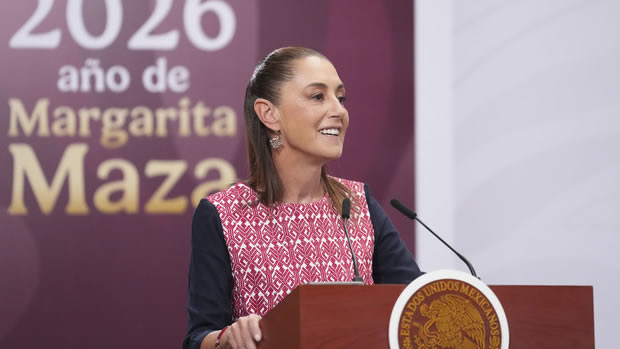
The incentives were announced by Mexican president Claudia Sheinbaum
Foto: gob.mx
After months of pressure from the audiovisual industry and a public debate that had been building since at least 2023, the Mexican government last Sunday formalised a national incentive for film and audiovisual production.
The announcement was made during a ceremony at the National Palace led by President Claudia Sheinbaum and was welcomed by the local industry, which highlights that Mexico will once again be competitive and that the effect will be “immediate.”
“It was essential to make Mexico competitive again. We were seeing productions that used to come to this country going to other territories and even how Mexican projects were starting to be filmed abroad due to the lack of incentives,” Mauricio Durán, president of the National Chamber of the Film Industry (Canacine), tells C21’s Spanish-language sister publication Cveintiuno.
Durán emphasises that the country already has advantages such as talent, technicians and a diversity of locations, but says the lack of a national incentive was a disadvantage compared to other territories. “The only thing missing was an incentive on par with those that exist around the world, and that is what allows us to compete again today,” he adds.
As explained during Sheinbaum’s announcement, the new scheme establishes a tax credit of up to 30% of income tax (ISR), with a maximum cap of MX$40m (US$2.3m) per project. In total, the incentive will have an annual budget of MX$400m (US$23.3m) and will initially be valid until September 2030.
The operating rules are due to be published in the coming weeks, which will be key to understanding how the tax credit and its transfer between taxpayers will work in practice. Even so, the president of Canacine anticipates an immediate impact.
“It’s a very good start. Today, the incentive is on par with competing countries, and we believe we will see results this year because the fund has already started to run, and many producers are going to apply,” Durán notes.
He also points out that behind the new incentive there was sustained coordination between associations, producers, screenwriters and federal agencies, as well as political pressure that ultimately unblocked the process. The goal is clear: to bring productions back, keep Mexican productions in the country, and translate the economic benefits into local jobs.
The incentive covers feature films, series, documentaries, animation, VFX, and post-production processes, with minimum spending thresholds and one key condition: at least 70% of the budget must be spent in Mexico.
Unlike other incentives in the region, the model does not operate as a cash rebate, but as a transferable tax credit, a technical distinction that, although relevant, does not change the substance of the announcement: Mexico is officially entering the international competition for major productions.
During the presentation, President Sheinbaum stressed that the goal is to attract global projects without losing sight of local development. “This incentive seeks to support productions that might otherwise not have the opportunity and, at the same time, attract international productions, while ensuring that Mexicans are hired in all film-related trades,” she said.
The Secretary of Culture, Claudia Curiel de Icaza, specified that both Mexican citizens and foreigners with permanent residence, as well as international producers working through a local resident, will be eligible to apply, thus reinforcing a model of coproduction and partnership with national companies.
The announcement comes after a period of growing concern within the sector. Local producers had been warning of a progressive loss of competitiveness compared to markets such as Colombia and Brazil, where incentives are already well established.
It is no coincidence that the new incentive came as an increasing number of Mexican projects began to migrate abroad and that international productions stopped considering the country as their first choice.
However, important questions remain. The fine print of the mechanism remains to be seen: how the tax credit will be transferred, how long it will take to recover the investment, and how responsive the technical committee in charge of approving projects will be.
Added to this is the underlying debate that already existed before the announcement: the government’s requirement for labour and tax formalisation as a condition for accessing the incentive, a point that continues to generate friction with part of the sector, especially in film production.
Even so, for Paul Vaca, a Mexican producer with experience in international coproduction and director of the MexCA talent incubator, the decree represents a long-awaited update. “Mexico is modernising to a way of doing audiovisual production that is already standard in other countries. Previously, we weren’t really in the conversation with Colombia and Brazil, but now we’re in the game.”
Vaca explains that the new scheme allows for attracting projects worth around US$6m, a scale that puts the country in a different league within the Latin American market. The 70% local spending requirement is also in line with international coproduction standards, facilitating access to complementary financing. “This allows us to play in larger projects. Productions that were not considering Mexico can now do so,” says Vaca.
He also rejects the idea that the incentive exclusively benefits large streaming platforms. “I don’t see it as a mechanism just for Netflix or Amazon. I see it as a tool to sustain the existing audiovisual social fabric: technicians, creatives, medium-sized producers who were previously unable to compete. The glass is now half full; before, the outlook was bleak,” he concludes.