

LA SCREENINGS: As linear TV’s fortunes continue to dip, so its share of the ad market follows, while YouTube and social video remain the biggest beneficiaries. C21 investigates how the US studios continue to recalibrate and make their case, as the upfronts this week revealed.
“YouTube is the new TV because creators are the new primetime,” said the Alphabet-owned streamer’s CEO Neal Mohan at the beginning of 2026.
It’s hard to argue with the claim. Last year, the company famously turned 20 and at the same time celebrated surpassing Disney to become the number one video platform on US TV screens, according to Nielsen – and this doesn’t mean eclipsing only Disney+ but the entirety of the Mouse House’s output, including Hulu, FX Networks, ESPN, Disney Channel and flagship broadcast network ABC.

Neal Mohan
Last month, Alphabet reported YouTube generated nearly US$10bn in first-quarter ad revenue, up over 10% on the same period 12 months earlier. Disney, meanwhile, stopped reporting revenues from its TV channels business in its first quarter on the basis that such figures are “no longer relevant” in a world of digital distribution.
Where the ad dollars are flowing and exactly what constitutes ‘primetime’ is, of course, relevant to the future of TV, and this week’s upfronts are the US industry’s traditional bellwether for tracking shifts. The way the event has changed over the years reflects this.
Having started out as the preserve of the ‘big three’ national broadcasters – ABC, CBS and NBC – cablenets later joined the party, along with Fox, and, more recently, the streamers – Netflix, Amazon, YouTube and others. The latter launched its own Brandcast event 15 years ago in a bid to appeal to ad buyers and joined the Internet Advertising Bureau’s (IAB) separate NewFronts initiative the year after. But these days, as YouTube has become more mainstream, it is a very firmly established part of upfronts week.
“This upfronts, YouTube stands alone as the future of media – going beyond traditional TV and shortform to offer advertisers the talent and solutions that deliver on all of their objectives. Welcome to the YouTube era,” said Anne Marie Nelson-Bogle, the company’s VP of ad marketing. She was speaking ahead of the company’s star-studded event at the Lincoln Center in New York on Wednesday, hosted by Trevor Noah (4.5 million YouTube subscribers) and featuring the likes of Dude Perfect (61.8 million), Jesser (38.5 million) and Adam W (21 million).
“These days, everything is on YouTube, everything – sports, entertainment, interviews, podcasts, you name it,” said Noah at the event, although original scripted drama remains a notable exception.

Trevor Noah
“For decades, the entertainment industry was built on a series of bets, programming shows based on formulas and focus groups and guessing what would make an audience show up. At YouTube, we didn’t wait for a focus group – we built a stage and empowered anyone with a story to find an audience,” opened Mohan, before unveiling a host of new titles, including travel show Trevor Noah’s World Tour and Haaland’s Gauntlet, with footballer Erling Haaland, and new ad products aimed at the assembled buyers.
The total US ad market across all media currently stands at between US$430bn and US$470bn, according to the IAB. YouTube’s share of this is around 3-5%, but when Google gets added into the equation, Alphabet constitutes between a quarter and a third of this. Back in the heyday of US broadcast TV, the national networks collectively could make the same claim. These days, they account for less than 10% of the total.
Linear TV upfront spending totalled US$17.8bn last year, down from US$18.4bn in 2024, according to Media Dynamics, marking three consecutive years of decline (this year’s figures are yet to be calculated). Broadcast TV networks’ primetime ad sales fell 2.5% to US$9.1bn – a figure that excludes sports, daytime, news and affiliate or local advertising.
But it’s not all doom and gloom. Over the year, 2026 is expected to deliver a welcome uptick in these areas with the Winter Olympics, Fifa World Cup and midterm elections helping total US ad spend grow 9.5%, and as a result linear TV is forecast to decline by 1.7% – a slower rate than in previous years – based on IAB projections.

Nielsen’s latest Media Distributor Gauge, covering February, in fact saw YouTube slip to second place behind NBCUniversal-Versant thanks to coverage of the Winter Olympics and Super Bowl LX on NBC, Peacock and USA Network. (Although the company has spun off its cable business into a separately listed entity, Nielsen still counts these together as the two share ad sales.) NBCU-Versant had a 13.1% share versus YouTube’s 12.7%, prompting the former to label the month “Legendary February.”
Indeed, NBCUniversal (NBCU)’s first-quarter domestic ad revenue leapt 135.3% year-on-year to US$3.5bn as a result, but strip out the Super Bowl and Olympics and growth was more steady, up just 4.7% to US$1.5bn but growth nonetheless. While NBCU doesn’t break down the contribution from Peacock, total revenue from the streamer (including subscriptions, advertising and distribution) was up 71% year-on-year to US$2.1bn.
But it’s hard to ignore the broader picture. A year ago, Nielsen declared “an historic TV milestone” as its findings revealed streaming had eclipsed combined broadcast and cable viewing for the first time, with the former accounting for 44.8% of TV viewership in May 2025, broadcast networks 20.1% and cable 24.1%. Last month, the research firm reported that, despite Legendary February, linear viewing continued to head south that month; broadcast saw a slight uptick to 21.7% but cable was down to 20% and streaming lifted its market share to 48%.
These shifts are reflected in the major established US media giant’s financials and how they are repositioning their businesses in a bid to follow the ad dollars.
Warner Bros Discovery’s Q1 ad revenue was down 8% year-on-year at US$1.85bn, partly due to the absence of NBA games, which have migrated to Disney’s ESPN, NBC and Amazon. While streaming advertising was up a significant 19%, this translated to only US$284m in revenue, whereas the biggest part of the ad business, global linear networks, declined 12% to US$1.6bn.
Paramount Skydance’s Q1 ad revenues declined 3% to US$2.4bn, with traditional TV advertising down 6% to US$1.9bn and streaming ads 9% higher at US$517m.
Fox Corp, meanwhile, saw ad revenue from its TV segment, including the Fox network and streaming business Tubi, dip nearly 30% to US$1.2bn for its latest quarter. This was, however, largely attributable to the absence of the Super Bowl, which it screened during the same period last year. Discount that and the division was estimated to be up 11%, with Tubi’s quarterly revenue up 23% while total view time rose by 19%. This was helped, the company said, by an expanded library of creator-led titles (it now hosts more than 220) and Tubi originals. The company also has coverage of next month’s Fifa World Cup to look forward to.
Disney, in its most recent Q2 earnings, reported a 5% rise in advertising revenue to US$1.7bn, out of a total US$25.2bn – up 7% year-on-year. “This growth reflects our expanding streaming revenues more than offsetting our declining linear revenues,” said new Disney CEO Josh D’Amaro. “We currently generate more entertainment subscription and affiliate fees and advertising revenues from SVoD than linear TV, and we expect the mix shift from linear towards streaming to continue.”
“Historically, the upfront was about securing placement in a limited amount of premium inventory, making sure advertisers had a seat at the table for the biggest moments on television. Today, the conversation is broader and more strategic; it’s about brands harnessing the full Disney ecosystem, and our reach and influence in linear, digital and streaming,” added Rita Ferro, the company’s president of global advertising.
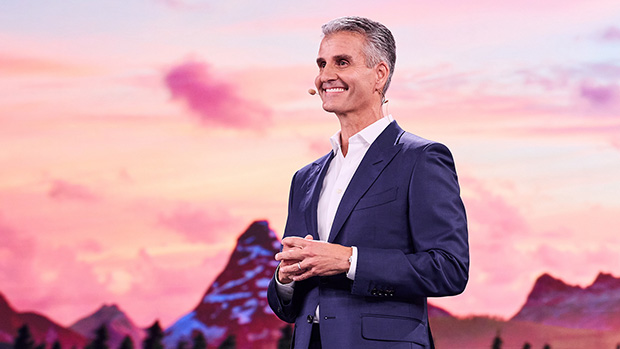
Disney CEO Josh D’Amaro at the Mouse House’s upfront
D’Amaro elaborated on all this in his first upfronts appearance on Tuesday, a glamourous event featuring everyone from Jimmy Kimmel to Robert Downey Jr, Olivia Rodrigo to Anne Hathaway and Shaquil O’Neil to Billie Jean King. Live sport is huge for Disney and will become more so as it rolls out a dedicated ESPN streaming product and looks ahead to hosting the Super Bowl for the first time next year.
“Everybody, in their own way, is racing to assemble something: studios, streaming services, sports rights, live events, brands that audiences feel something about. It is, in a way, a real compliment to this company because what they are racing to assemble is, more or less, the picture of what we already are,” he said.
The message, to both Madison Avenue and Wall Street, is that wherever the frontline of the ongoing streaming wars lies, Disney is there and has lots more to offer besides. This was underscored by the company’s latest quarterly results – D’Amaro’s first in charge – in which the theme parks division he previously led contributed US$9.5bn of the group’s total US$25.2bn revenue, both up 7% year-on-year, while revenue from Disney+ and Hulu stood at US$5.5bn, albeit rising by a more impressive 13%.
There’s little dispute that the key battleground is what the IAB defines as ‘digital video’ – a category spanning connected TV (CTV), online video and social video (including YouTube) – which is on track to top US$80bn in US ad revenue this year having grown 20% faster than the total ad market), according to figures released this month by the organisation. This is up on last year’s US$78bn, which was itself a massive 25.4% year-on-year leap from 2024. Digital video accounted for 26.5% of the total internet advertising market in 2025, an IAB/PwC measure that also includes social media, commerce, search, podcasts and display, and which as a whole rose 13.9% in 2025 to U$294.6bn.
YouTube pulled in over US$40bn last year so the number is likely to rise for 2026. This is on a global basis, but estimates suggest the US accounts for some 35–45% of these figures, meaning it generated between US$14bn and US$18bn for Alphabet in 2025 – amounting to around 20% of the US digital video ad market.
Media Dynamics notes that upfront spend on streaming surged 17.9% to US$13.2bn last year while another research firm, eMarketer, found US CTV’s upfront ad spending will exceed primetime linear TV’s for the first time this year, coming in at US$17.7bn versus US$17bn. With YouTube now averaging above 12% of total US TV usage, according to Nielsen, this would mean it potentially gleans over US$2bn.

“Video is still capturing a growing share of incremental digital advertising revenue relative to other formats,” said the IAB in its annual report last month.
Social media ad revenues grew the most, however, in 2025 – up 32.6% or US$29bn to US$117.7bn, driven by “the scaling of the creator economy, deeper commerce integration, and continued performance improvements in targeting, measurement and attribution.”
A fast-emerging category that straddles those the IAB/PwC delineates is ‘creator advertising’, described as now a “core media channel” and one that totalled US$37bn in 2025, projected to reach US$44bn this year.
“Brands are embedding creators into long-term media strategies, operational workflows, and even product development. What was once campaign-based influencer marketing is evolving into always-on creator programmes, with brands building dedicated teams and tools to manage the partnerships at scale,” said the IAB/PwC.
Again, quite how this is quantified is hard to divine as streaming and, indeed, broadcast TV become increasingly infused by brand-savvy/supported YouTubers for whom product placement is second nature, even raison d’être. “Consumer behaviour is continuing to shift toward video, creator-led content and performance-driven environments – reshaping where and how ad dollars are spent,” said the IAB/PwC.
Also this week, Netflix unveiled a glut of new titles at its own upfront and restated projections that it’s on track to hit US$3bn in ad revenue this year – double what it achieved in 2025. The company has gone a long way to incorporate ‘creator-led’ content into its line-up, assimilating the likes of Ms Rachel, The Sidemen and Jake Paul. eMarketer estimates US$2.4bn of Netflix’s 2026 ad monies will come from the US and pegs the equivalent figure for Amazon Prime Video, home of MrBeast’s Beast Games, at US$3bn.
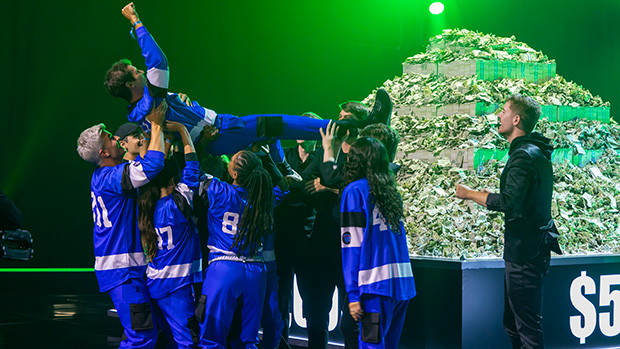
MrBeast paired with Amazon on his Beast Games format
Intriguingly, Amazon, like Disney, largely steered clear of YouTubers in its upfront, similarly leaning instead on established Hollywood-centric talent like Michael B Jordan, Chris Pratt, Arnold Schwarzenegger and Oprah Winfrey, but also playing towards its own Twitch gaming community, music and, in a major way, sport, celebrating its NBA and Nascar coverage, Thursday Night Football (TNF) and more.
“Prime audiences don’t merely tune in, they lean in,” said TNF host Charissa Thompson. “Our audience is younger and more likely to engage with advertised brands than sports viewers on any linear network.”
This reflected one of the strongest themes running through this year’s upfronts.
“Streaming platforms are increasingly investing in the rights to live sports and real-time events while expanding ad-supported tiers to attract larger audiences. This is creating more premium inventory and intensifying competition for video advertising budgets,” said the IAB in its PwC report last month.
The US majors are continuing to play to their strengths in this context while adapting their businesses to the fast-changing streaming landscape.
YouTube’s Mohan may believe the platform is the new TV and creators are what audiences crave – certainly the movement of ad dollars suggests this too – but Disney’s D’Amaro isn’t done and perhaps fired off a broadside against this argument. “The thing is, you can’t acquire 100 years of trust. You can’t put generations of belonging on a balance sheet,” he said.