Kids' TV commissioning shrinks as YouTube builds a new ownership model
MIPJUNIOR: Ampere Analysis research presented in Cannes today shows kids’ commissioning by broadcasters shrinking while YouTube-first owners and creator deals reshape how kids’ IP is built and financed.
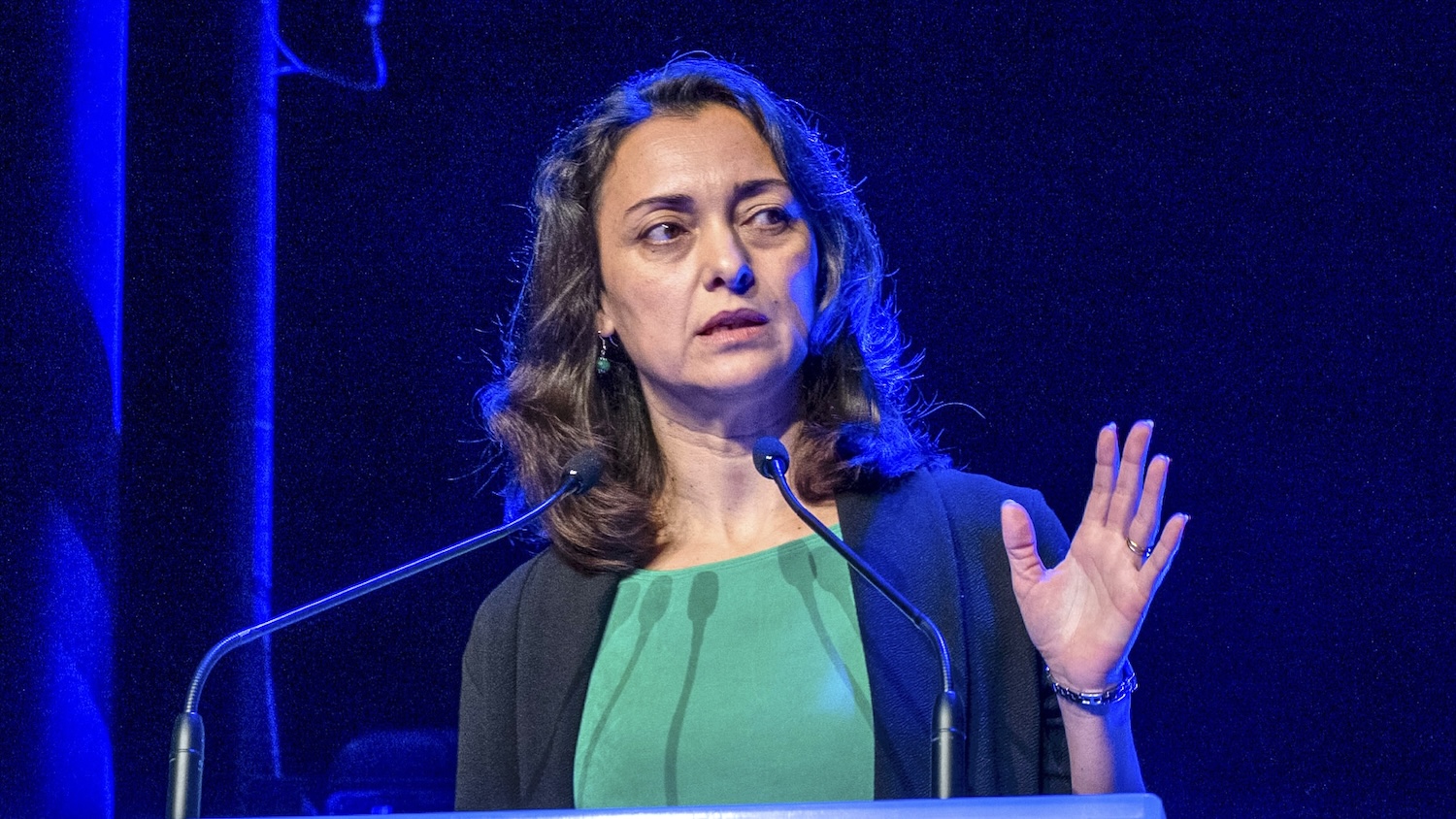
Ampere’s Cyrine Amor speaking at MipJunior today
Producers and distributors of children’s content are working in a market where traditional commissioning continues to contract, young audiences spread their attention across more services than any other age group, and the route to building franchises increasingly runs through YouTube, according to new research from Ampere Analysis.
Presenting a year-end snapshot of the sector at MipJunior in Cannes, Cyrine Amor, senior research manager at Ampere, set the kids’ market against a wider media backdrop in which subscription OTT revenues are forecast to reach US$174bn globally in 2026, ahead of pay TV at US$163bn, while other online video advertising is forecast to hit US$292bn. Subscription OTT net additions, however, have slowed from 270 million in 2020 to 80 million in 2023, with Ampere’s chart pointing to the introduction of lower advertising-supported subscription tiers by leading global services, before recovering to 160 million in 2024 and easing back to a forecast 110 million in 2026.
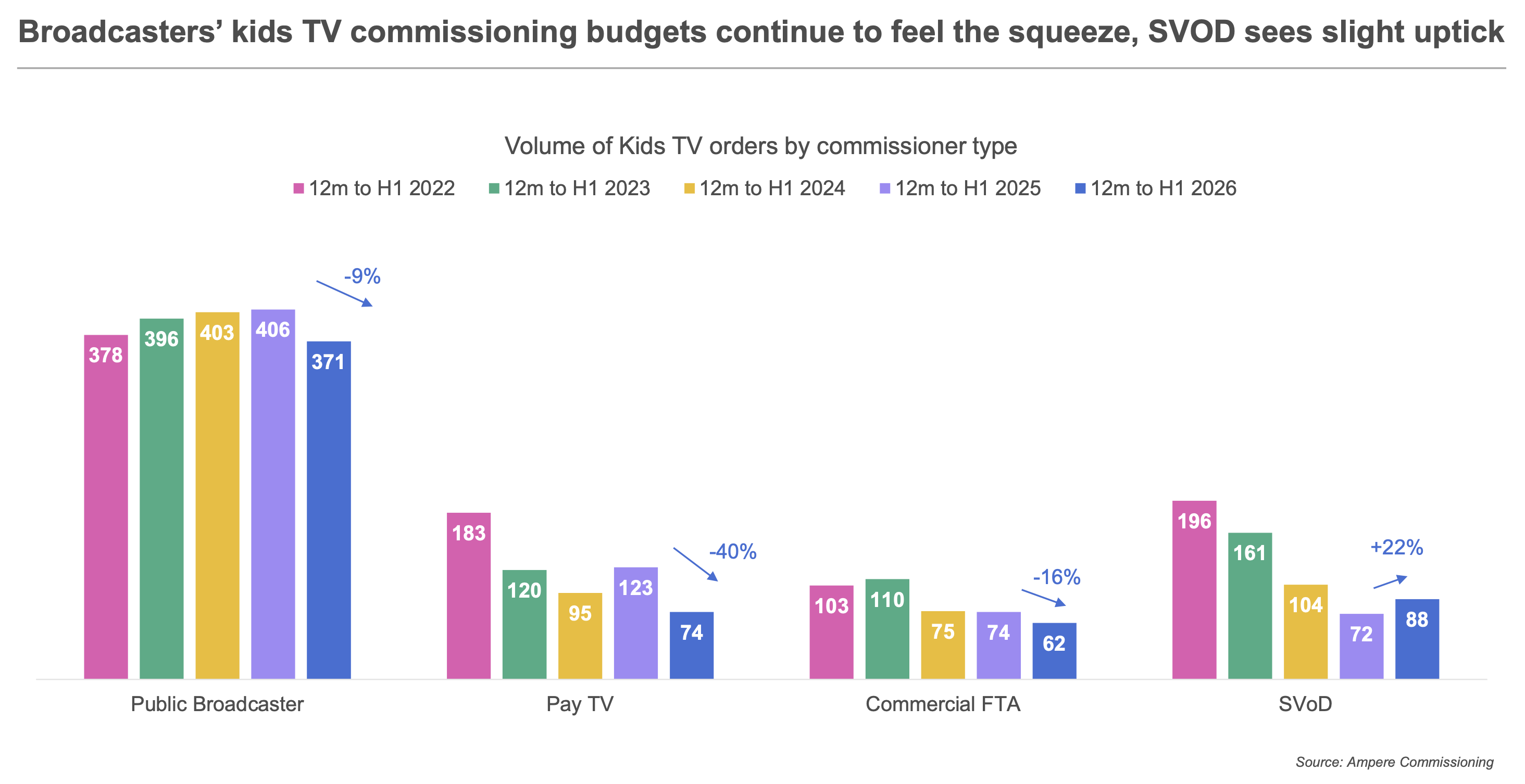
Within that setting, the data on kids’ TV commissioning points to continued pressure on broadcasters. Ampere’s figures show that orders from public broadcasters fell 9% in the 12 months to H1 2026, from 406 to 371, although they remain by far the largest commissioning group. Pay TV orders dropped 40%, from 123 to 74, while commercial free-to-air orders slipped 16%, from 74 to 62. The one category to move upwards was SVoD, said Amor, where orders rose 22% from 72 to 88, albeit from a long way below the 196 recorded in the 12 months to H1 2022.
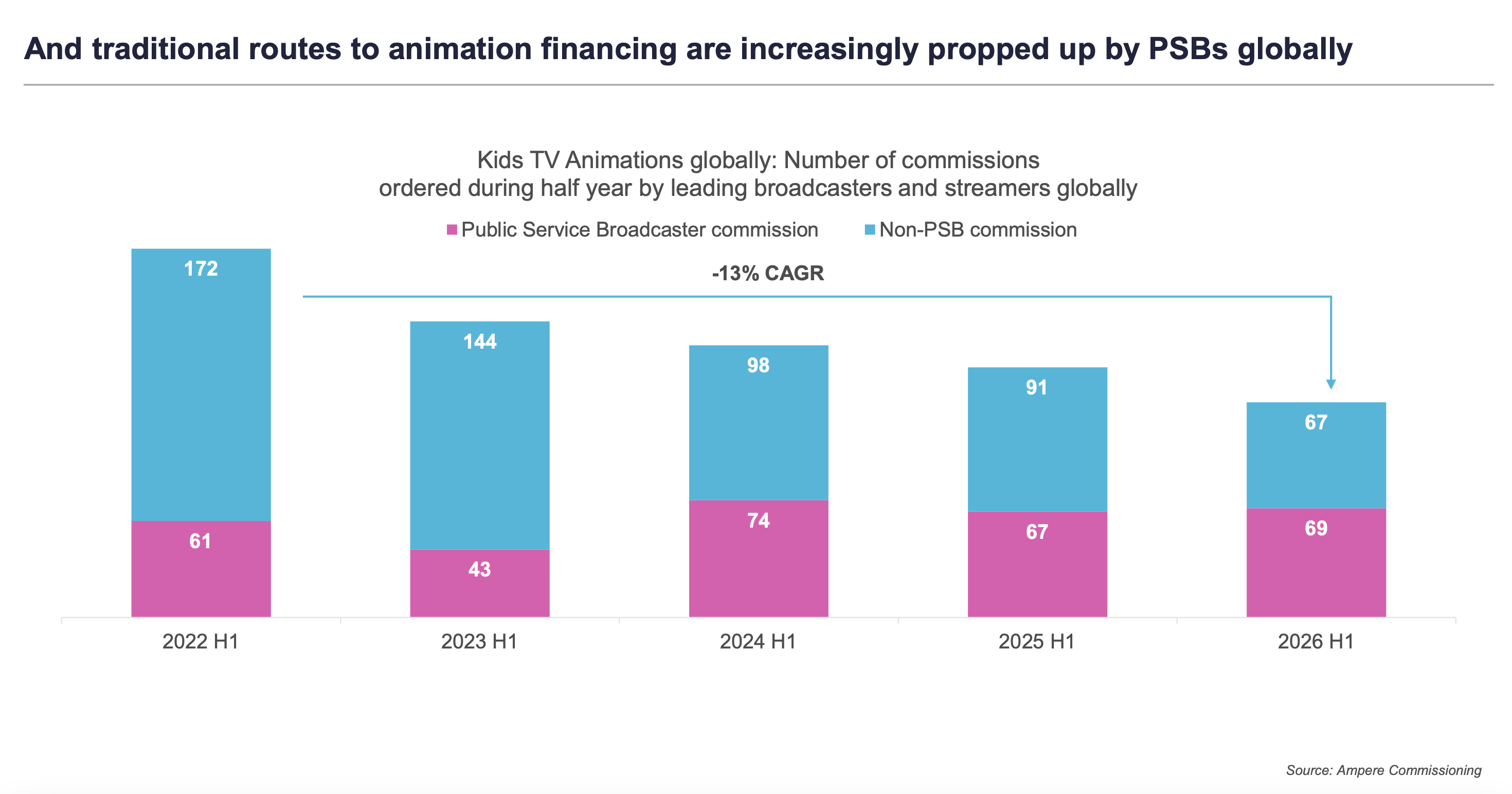
The picture is starker for animation. Ampere counted 172 non-PSB commissions of kids’ TV animation globally in H1 2022 and just 67 in H1 2026, while public service broadcaster commissions moved from 61 to 69 over the same period, peaking at 74 in H1 2024. Ampere puts the overall decline at a 13% compound annual rate, and Amor told MipJunior delegates that traditional routes to animation financing are “increasingly propped up by PSBs globally”.
As commissioning tightens, YouTube is emerging as the other centre of gravity for kids’ IP. Ampere identifies 250 kids’ channels with more than 10 million subscribers, with 300,000 hours in total across videos, shorts and livestreams, of which 80% are preschool channels. The ownership of those channels looks very different from the traditional kids’ business. Some 55% are owned by digital specialists or animation studios, and 23% by individual creators or families, while non-digital animation studios account for 9%, toy and gaming companies for 4%, and major US studios and SVoDs for just 2%. A further 8% fall into other company types.
Branding follows a similar logic. The largest share of these channels, at 31%, is branded around the show or franchise IP they carry, while 29% feature the name of the YouTube creator or family. One in five is thematically branded, around areas such as songs and rhymes, educational themes or play, and one in ten combines brands, such as a company name and show IP. Only 9% of the top-performing channels feature a company name, a finding Amor framed as “new rules for building distinctive channel brands”.
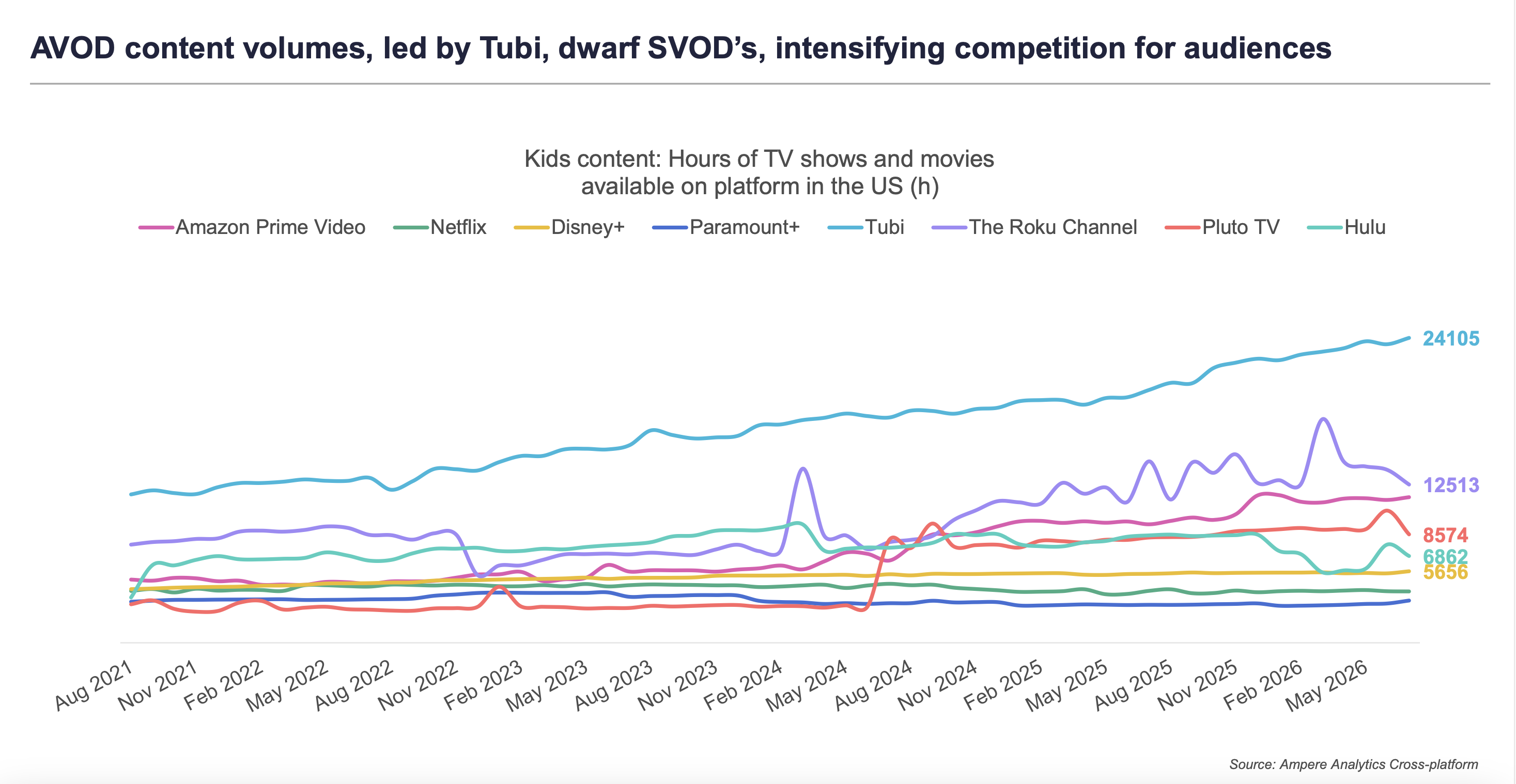
Those brands are competing for attention in an extremely crowded field. Amor said the kids’ content available on SVoD services at 245,000 hours globally, including 51,000 hours in the US and 4,000 hours on Netflix, with AVoD offering 140,000 hours globally, 45,000 of them in the US and 24,000 on Tubi.
In the US, Tubi’s kids’ catalogue stood at 24,105 hours by the end of the period charted, ahead of The Roku Channel at 12,513, Amazon Prime Video at 11,512, Pluto TV at 8,574, Hulu at 6,862 and Disney+ at 5,656. Netflix had 4,062 hours and Paramount+ 3,341. Amazon was the one SVoD to expand its catalogue meaningfully, while Amor noted that kids’ originals investment has fallen elsewhere.
The audience itself is also harder to pin down, said Amor. According to Ampere’s Attention Economy Survey of 2,000 respondents in the US and UK, conducted in April 2026, Gen Alpha accesses 14 different media services per week, 18% more than the base average, while Gen Z is 3% below it and Baby Boomers 25% below.
Their habits also differ sharply from the generation before them. Gen Z turns to streaming services to relax, be immersed, discover something new and take their minds off things, and to social media when they want to do something with family or friends or when they are bored. For Gen Alpha, gaming is the primary service when they want to be immersed, take their minds off things or are bored. Music subscriptions lead when they want to sit back and relax, YouTube when they want to discover something new, and streaming services when they want to do something with family or friends.
Streamers are responding by leaning on what is already proven. Ampere found that the share of “new content” hours, defined as those first released during the previous five years, in Netflix’s US kids’ catalogue fell from 48% in July 2022 to 36% in July 2026. Amazon Prime Video’s share dropped from 22% to 11% and Disney+’s from 23% to 13%, while Tubi’s moved from 14% to 13%. The data shows SVoD catalogues “leaning more heavily on older, established content,” said Amor.
Exclusivity is loosening too, she added. The share of Netflix’s kids’ content hours held non-exclusively with other global streamers, namely Apple TV+, Disney+, HBO Max, Paramount+ and Amazon Prime Video, rose from 17% in January 2023 to 21% in July 2026. By July 2026, most of those shared titles were held with Paramount+ and Prime Video, and consisted primarily of major franchise IP from Nickelodeon and toy franchise content.
At the same time, the major platforms are increasingly doing deals with YouTube-first creators and companies. Moonbug Entertainment has featured in agreements with Netflix, Amazon Kids+, HBO Max and Prime Video since 2021, and Pocket Watch with Disney+ from the same year. In 2025, Netflix struck deals with Ms Rachel and Mark Rober, while Hulu and Disney+ added Pocket Watch content including ChuChu TV. The 2026 list is the longest, with Netflix deals including Alan Chikin Chow, Salish & Jordan Matter, Stokes Twins, Danny Go, Steve & Maggie, BabyBus and ChuChu TV; Disney+ deals including Gracie’s Corner, Like Nastya and Pocket Watch, and Prime Video deals with Pinkfong and Pocket Watch.
Amor’s conclusion for the Cannes crowd was that “the bar is now higher for kids’ IP to stand out”, with building engagement increasingly requiring a presence across multiple media services, and gaming an important part of the wider ecosystem. With traditional commissioning finance under pressure, the Ampere exec said that “partnership-building is increasingly critical”, requiring producers to diversify funding and tap alternative sources including wider kids’ brands and non-media partners.
Merchandising, music, live experiences and cross-IP collaborations, traditionally pursued downstream, now need to enter the financing mix earlier. And because YouTube monetisation is limited for kids’ content, Amor said new IP can use the platform to build audiences and prove value, helping to unlock commissions, licensing and other financing.
Finally, Amor argued that kids’ IP must balance “local relatability with international portability”, as PSBs – which prioritise local relevance – account for a growing share of traditional commissions, while concepts that travel remain key to unlocking global platforms and scale.